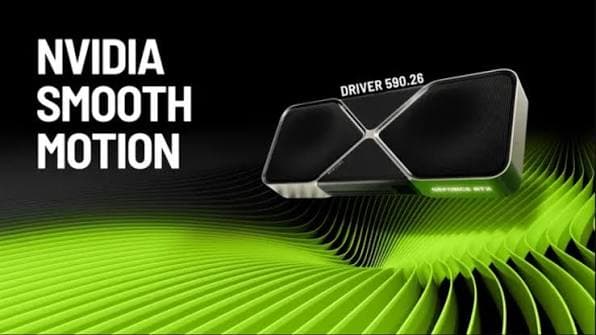
Nvidia's new Smooth Motion feature in the Nvidia App brings driver-level frame generation to games without native support. This allows older AAA titles to benefit, though an RTX 40-series GPU is required for use.
Nvidia is expanding the reach of frame generation technology with a new feature called Smooth Motion, integrated directly into the Nvidia App. This driver-level solution promises to bring frame generation to many older games that never received native support for technologies like DLSS FG.
As XDA Developers reported yesterday, Smooth Motion works by operating at the driver level, meaning it does not rely on specific motion vectors or depth information from the game engine. This is a significant distinction from DLSS FG, which requires direct integration by game developers.
The biggest implication for Indian PC gamers is the ability to enable frame generation in a vast library of titles that launched before the technology became widespread. Games like God of War and Resident Evil 4, which are still very popular, could see a boost in perceived smoothness without developers needing to revisit them.
Even games with engine-level FPS caps, such as Elden Ring, Sekiro: Shadows Die Twice, and Dark Souls III, can reportedly benefit. Smooth Motion does not remove these caps, which helps avoid issues where game mechanics or physics are tied to frame rate, a common problem in titles like Fallout 4. Instead, it makes the gameplay look smoother, particularly beneficial for those with high-refresh-rate monitors.
There's a catch, though: you will need at least an RTX 40-series GPU to use Smooth Motion. This limits its accessibility for users with older Nvidia cards, or those with AMD or Intel GPUs.
For gamers without an RTX 40-series card, third-party tools like Lossless Scaling remain an option. Lossless Scaling is compatible with a broader range of GPUs from Nvidia, AMD, and Intel, and offers more flexibility, including the ability to generate multiple frames for every rendered frame. However, XDA Developers noted that for older, less demanding titles where base frame rates are already decent, Smooth Motion's simpler, integrated approach within the Nvidia App is appealing, avoiding the need for another background application.
Smooth Motion shares some inherent drawbacks with other frame generation technologies. It does not actually improve a game's responsiveness, despite making the FPS counter climb. The added input latency can even make things feel worse if the starting frame rate is already low.
Furthermore, because Smooth Motion lacks access to game engine data like motion vectors and depth information, it can be more prone to visual artifacts compared to native DLSS FG. These artifacts might be noticeable around fast-moving objects and HUD elements, as highlighted by XDA Developers.
While native DLSS FG is generally preferred where available, Smooth Motion serves as a valuable fallback option. For older games that are not particularly demanding by today's standards, higher base frame rates might make the added input latency less bothersome. XDA Developers also mentioned it can be useful when native implementations clash with other features, such as HDR, providing a workable alternative to choppier gameplay.