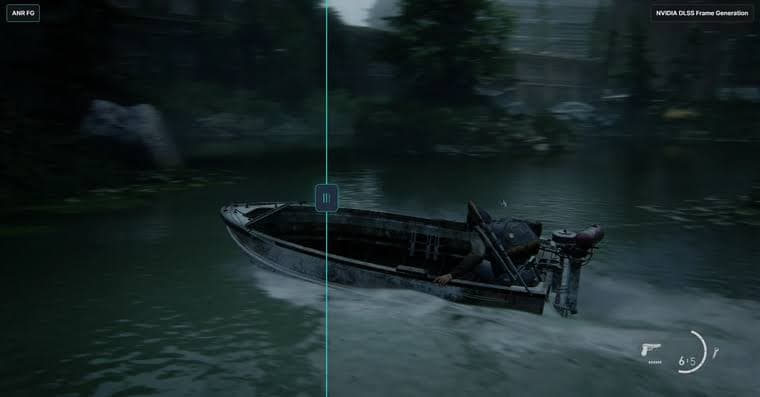
Apex Compute announced its ANR FG frame generation tech on November 11, 2026, bringing the feature to older GeForce, Radeon, and Arc GPUs. It aims to offer an alternative to NVIDIA's official DLSS Frame Generation for a wider range of hardware.
Apex Compute announced its Apex Neural Rendering (ANR) technology on November 11, 2026, releasing a public beta of its frame generation feature, ANR FG. This new AI-based image processing technology aims to bring frame generation capabilities to a much wider range of graphics cards, including older models often found in Indian gaming setups.
Unlike NVIDIA's official DLSS Frame Generation, which currently supports only the newer RTX 40 and RTX 50 series GPUs, ANR FG reportedly works with a broader spectrum of hardware. This includes NVIDIA's GeForce GTX 16 series and RTX 20/30 series, as well as AMD Radeon and Intel Arc GPUs. The company also confirmed support for the Steam Deck, along with Windows 10/11 and Linux/SteamOS via Proton.
Frame generation works by inserting new, AI-generated images between frames rendered by the game engine, which can significantly increase the displayed frame rate. For example, at 2X, one generated frame is added for each rendered frame, while at 4X, three new frames are added.
Apex Compute has published comparison results against NVIDIA DLSS, claiming ANR FG offers shorter processing times and lower GPU memory usage. In tests conducted by the company on an RTX 5090 at 3840x2160 (4K) resolution, ANR FG recorded processing times of 1.01 ms at 2X, which is about 19.8% shorter than DLSS's 1.26 ms. At 4X, ANR FG averaged 0.61 ms per generated frame, approximately 25.6% shorter than DLSS's 0.82 ms.
The company also stated that ANR FG used considerably less GPU memory in these tests, at 214 MB compared to DLSS's 562 MB, a reduction of about 61.9%. Apex Compute noted that ANR's model weights are 0.17 MB, a separate figure from the runtime GPU memory requirement.
It's important to remember that these figures from Apex Compute reflect the time and memory needed for the frame generation process itself. They do not directly translate to an overall game frame rate increase of 20-26%. Actual in-game performance depends on various factors, including CPU and GPU load, and graphics settings. Input responsiveness also does not improve at the same rate as displayed frames.
Beyond performance, Apex Compute also published image quality comparisons. In a 2X frame generation test, the image quality metric CGVQM-5 mean patch scored 96.59 for ANR against 93.66 for DLSS, indicating a lead for ANR. The company also claimed higher values on other quality metrics from 2X through 6X.
However, as XenoSpectrum reported, the published quality table lacks sufficient explanation regarding the number of test scenes or how results were aggregated. NVIDIA's DLSS is also constantly updated, and it's unclear if the DLSS models and presets used in Apex Compute's comparisons were the most current or optimal. Thus, it cannot be generally concluded that ANR delivers higher image quality than DLSS, as quality can vary significantly by scene and settings.
To implement ANR FG, users need OptiScaler, a tool that allows swapping out frame generation and super-resolution technologies. Apex Compute provides “Full” and “Addon” versions depending on whether OptiScaler is already installed in a game. Frame generation must also be enabled within the game itself.
A crucial warning for Indian gamers, as reported by XenoSpectrum, is that OptiScaler's developer advises against using it in online games. Anti-cheat systems in many online titles might flag OptiScaler as an unauthorised modification, potentially leading to account bans. While ANR FG supports a broad range of GPUs, this doesn't mean it's safe to use in every game, especially competitive online ones.
Apex Compute is also working on super-resolution and ray reconstruction technologies, but these are still in the training phase. For now, ANR FG offers an interesting alternative for Indian PC gamers looking to boost frame rates on their existing, older hardware, provided they understand the limitations and risks, particularly concerning online multiplayer titles.