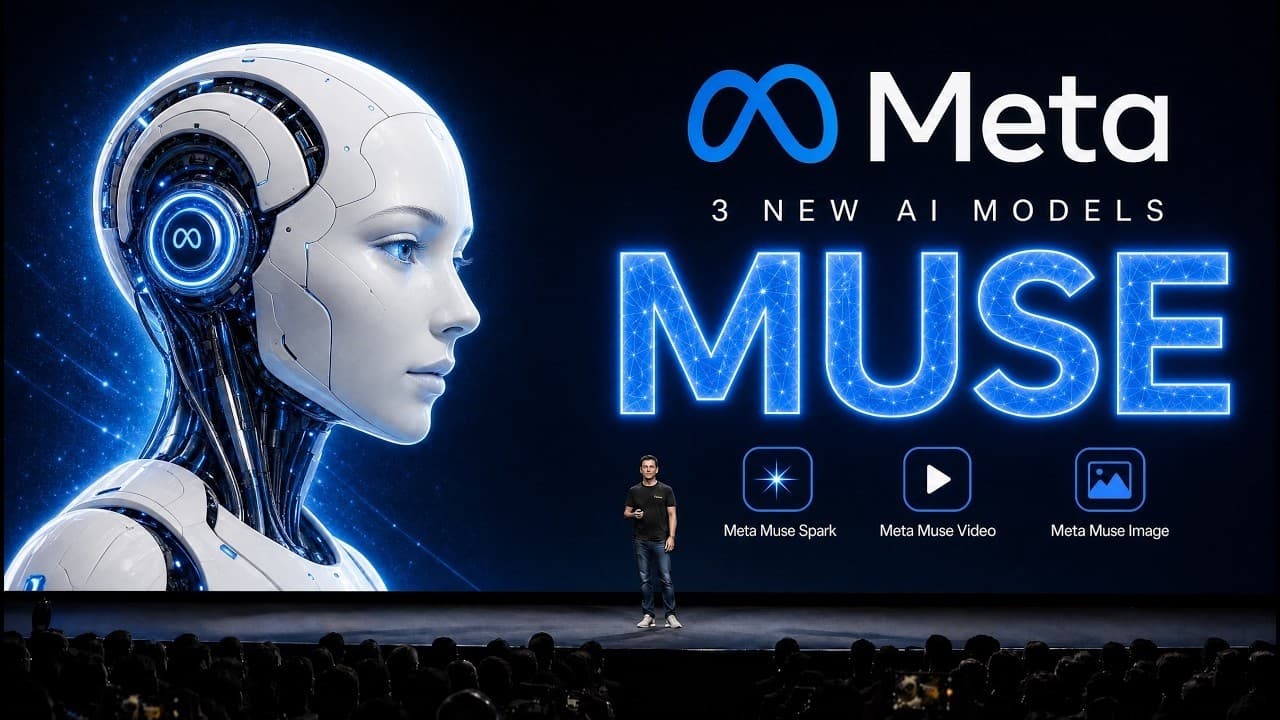
Meta has launched its new Muse Wonder and Muse Wonder Full AI models, showing major performance improvements especially in complex tasks and coding. These models are now among the best available globally, according to new benchmarks.
Meta has released its latest frontier AI models, Muse Wonder and Muse Wonder Full, both of which have quickly landed among the top-tier AI models available today. This marks a significant jump for Meta, which seems to have recovered after a weaker stretch with its open Llama models, according to The Decoder.
Muse Wonder Full Leads Performance
The more powerful Muse Wonder Full scored 56 points on the Artificial Analysis Intelligence Index v4.3, while Muse Wonder achieved 52 points. This is a substantial improvement over their predecessor, Muse Spark 1.3, which sat at 48 points. The biggest gains are evident in agentic evaluations, which measure how well an AI can handle complex tasks autonomously. On Terminal-Bench 4.0, performance for the new models jumped from 33 to 57 percent.
Muse Wonder Full has placed in the top three on six out of ten benchmarks overall. This suggests Meta is making serious strides in developing AI capable of more sophisticated, multi-step operations.
Active Memory and Focus Features
Meta is highlighting two new features that are central to its vision of a personal AI agent: Active Memory and Active Focus. Active Memory allows the model to retain key information across conversations and recall it when needed. Active Focus helps the model persevere with difficult tasks, try alternative approaches, and ask clarifying questions when faced with ambiguity. These capabilities are crucial if Meta aims for a personal AI that can access calendars, messages, and documents for users.
Enhanced Coding and Broader Inputs
Both Muse Wonder models support a one-million-token context window and accept diverse inputs including text, images, video, and audio. Coding performance has seen significant improvements as well. Muse Wonder Full scored 68 points on the Coding Agents Index, tying it with Claude Code with Sonnet 5.5. Muse Wonder also improved, scoring 63 points, up from 54 for its predecessor.
Factual Knowledge Still a Weak Spot
Despite these gains, factual knowledge remains an area where the Muse Wonder series lags. On the AA-Omniscience knowledge test, Muse Wonder Full managed only 30 points, and Muse Wonder scored 25. This puts them behind rivals like Claude Opus 5.5 (46), GPT-6 Astra (43), and Gemini 4 Argon (42), suggesting the Wonder series might be built on a smaller base model compared to its competitors. However, Meta has managed to significantly reduce hallucination rates. Muse Wonder Full cut its hallucination rate from 33 to 23 percent compared to its predecessor, making it the second-lowest among all models scoring at least 45 index points, with only Gemini 4 Argon (15 percent) performing better.
Availability and Pricing for Developers
For developers, Muse Wonder is available through Meta's API and Muse Code. Muse Wonder Full is currently limited to Muse Code users. Meta plans to integrate Muse Wonder into its Muse app soon, starting with paying subscribers, with specialized models eventually coming for all users.
Regarding costs, Muse Wonder runs $4.52 per task on the Intelligence Index, which is nearly three times more than its predecessor, Muse Spark 1.3 ($1.60). Token pricing has also increased to $4 per million input tokens and $20 for output tokens, up from $1.25 and $4.25 respectively for the older model. Muse Wonder also uses 28 percent more input tokens per task, accounting for 76 percent of total costs.
This pricing places Muse Wonder below Claude Fable 5.1 ($7.63) and Claude Opus 5.5 ($5.98) but above GPT-6 Astra ($3.26), Gemini 4 Argon ($1.99), and GPT-6.1 Sol ($0.72). Token pricing for Muse Wonder Full has not been released yet.
What This Means for Indian Developers and Users
For Indian developers and businesses exploring AI, Meta's Muse Wonder models present a compelling option, particularly given their strong performance in agentic tasks and coding. The focus on creating personal AI agents with 'Active Memory' and 'Active Focus' could lead to more sophisticated AI applications that integrate deeply with user data, potentially enhancing productivity tools and digital assistants. While the factual knowledge gap is notable, the low hallucination rates are a big plus for reliability, which is crucial for any AI deployment.
The pricing for Muse Wonder, while higher than some direct competitors like GPT-6 Astra and Gemini 4 Argon, is still competitive with other top-tier models. Indian developers will need to weigh the performance gains, especially in coding and complex tasks, against the cost when choosing an AI model for their projects. We will have to wait and see how Meta expands access and rolls out specialized versions for the broader user base in India.