An XDA Developers writer has cancelled their ChatGPT subscription, finding that local LLMs running on an 8GB GPU, alongside Claude Pro and Gemini, now cover their workflow needs.
A writer at XDA Developers, Nolen Jonker, has stopped paying for their ChatGPT subscription. Jonker, like many in the tech space, was paying for multiple AI chatbot services, including Claude Pro and Google AI Pro (Gemini), at around $20 (approximately ₹1,670) each per month. However, they found that the capabilities of local Large Language Models (LLMs) running on consumer hardware, specifically an 8GB GPU, made ChatGPT redundant for their workflow.
Claude Pro and Gemini Remain Essential
After auditing their AI usage, Jonker found that Claude Pro handled most of their heavy lifting, including research, design work, and coding. Claude's Opus 5.5 model was a favourite for general tasks, while Claude Code and Cowork were used for Obsidian vault management and computer administration, respectively. These features came bundled with the Claude Pro subscription.
Google AI Pro, or Gemini, also proved indispensable for studying and research. Jonker highlighted Gemini's Deep Research feature and its versatile Canvas workspace, which can adapt into various formats like documents, interactive prototypes, or code editors. Access to Gemini Notebook (formerly NotebookLM), with its increased limits of 500 notebooks, 300 sources per notebook, and four times the AI usage allowance, was another key reason for the Gemini subscription. This also provided larger context windows and access to advanced models, Antigravity, and Google Labs tools.
ChatGPT's Diminished Role
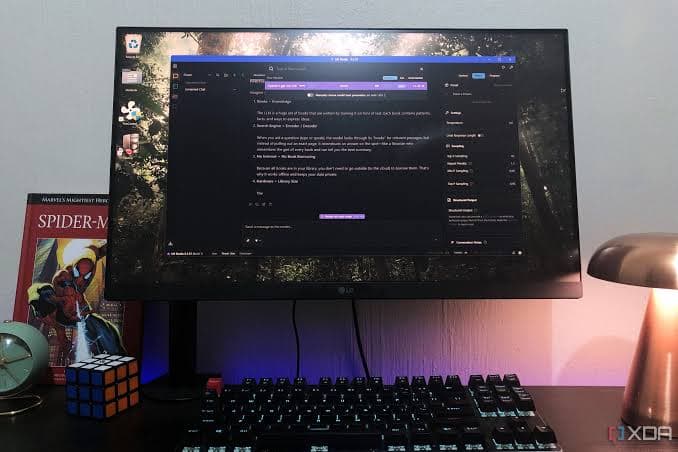
With Claude and Gemini covering core productivity, and local LLMs handling private documents and specific workflows, ChatGPT’s utility for Jonker was limited to experimenting with its newer flagship models. The writer noted that even general chat questions often yielded similar results from free local models compared to GPT models when tested side-by-side in Cherry Studio, a local AI workspace. This meant they were increasingly using the GPT models via API calls, paying per message, which worked out cheaper than the $20 monthly subscription for infrequent use.
The Rise of Local LLMs on an 8GB GPU
A significant factor in cutting the ChatGPT subscription was the growing power of local LLMs. Jonker runs these models on an Nvidia RTX 3070 graphics card with 8GB of VRAM. Their setup uses Cherry Studio to integrate both cloud and local AI models, with LM Studio managing the local server.
For general chat, Jonker uses Qwythos 9B v2, a community fine-tune of Qwen 3.5 9B. This model, running as a 4-bit Q4_K_M file, occupies about 5.7GB of VRAM and fits entirely on the RTX 3070. Heavier analysis tasks are handled by Qwen 3.5 9B (Q4_K_M), while Gemma 4 E4B is employed for quick lookups using the Brave Search MCP plug-in within LM Studio.
However, the 8GB VRAM limit of the RTX 3070 presents a hard cap. The model file needs to share memory with its context (the amount of conversation it can hold), meaning Jonker tops out at a 4-bit 9B model with around 30,000 tokens of context. Larger models like Gemma 4 12B were reportedly laggy, even in Google's QAT Q4_0 version, and fitting models like Qwen 3.6 27B or 3.8 27B on the card wasn't feasible.
What This Means for Indian Users
This shift towards local LLMs holds particular relevance for Indian tech enthusiasts and professionals. The combined cost of multiple $20 monthly subscriptions, which can add up to over ₹5,000, is a significant expense. If a mid-range GPU, like the RTX 3070 (a popular choice in the Indian PC building community), can offload many AI tasks, it offers a compelling cost-saving alternative.
While the initial investment in hardware might be higher, the ability to run powerful AI models locally, without recurring subscription fees for basic tasks, could become an attractive option. As local LLMs continue to improve and become more efficient on consumer hardware, we could see more Indian users exploring this path to reduce their reliance on costly cloud-based AI subscriptions.