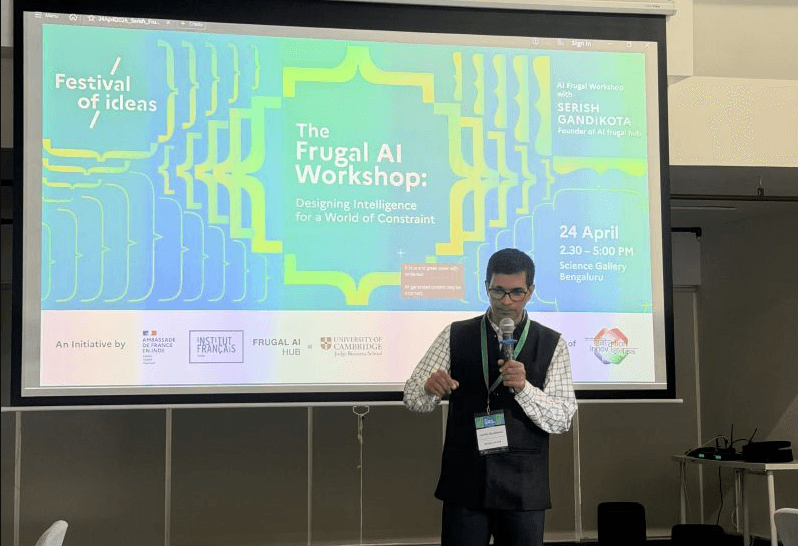
Serish Gandikota, co-founder of the Frugal AI Hub at Cambridge University, says India needs to develop its own AI solutions tailored for local needs. He highlights how the Hub is collaborating with the Andhra Pradesh government.
Serish Gandikota, co-founder of the Frugal AI Hub at Cambridge University-Judge Business School, advocates for India to build its own AI solutions tailored for local needs, rather than simply reacting to Silicon Valley's agenda.
Gandikota, who also leads the Hub’s Frugal AI Deployment Labs, has worked on frugal innovation across Europe, India, and Africa. He emphasizes that 'frugal' isn't about making cheaper versions of existing tech, but about fundamentally rethinking the solution itself.
He draws on an experience from his glacier research, where expensive equipment failed. Gandikota cites the Embrace baby warmer, developed by Stanford students, as a prime example of frugal innovation. This portable solution costs around $200 and works without electricity, a stark contrast to conventional $20,000 incubators that rely on stable power.
For Gandikota, this thinking applies directly to artificial intelligence. He believes Silicon Valley's AI development, often backed by immense resources, isn't directly replicable or even desirable for countries like India. Instead, the focus should be on achieving similar outcomes through different, context-appropriate approaches.
The Frugal AI Hub officially launched in April 2025 at Cambridge. It aims to address the real costs and impact of AI projects. The Hub collaborated with the UN International Computing Centre (UNICC) on a report called 'Total Cost of Ownership to Social Impact,' examining how organisations can evaluate AI's return on investment and its score against Sustainable Development Goals.
A significant part of the Hub's strategy involves establishing deployment labs in various geographies. In November 2025, the Hub signed an MoU with the Andhra Pradesh government under the Amaravati Quantum Valley initiative. They are now working to develop a digital course on frugal AI and set up a dedicated Frugal AI lab in Amaravati.
Discussions are also underway with the Telangana government, further cementing the Hub's commitment to fostering AI innovation within India.
Gandikota believes the dominance of Silicon Valley's AI narrative is problematic. 'The conversation coming out of Silicon Valley is taking up all the oxygen in the room,' he said, urging countries like India, the UK, and Europe to avoid simply reacting.
He stresses the importance of asking fundamental questions: 'Do you really need AI?' Gandikota states that just because others are doing it, one does not need to have a 'fear of missing out.'
While edge computing and on-premises solutions are relevant, Gandikota views Frugal AI primarily as a design philosophy and systems architecture. The core idea is to start with desired outcomes and then determine the necessary technology, rather than beginning with technology and seeking an output.
Honestly, Gandikota's perspective feels incredibly relevant for India. With its diverse socio-economic landscape and varying infrastructure, a 'people-first' AI approach, focused on outcomes and local constraints, stands to deliver much more genuine impact than simply trying to mirror Western tech trends. It's a call for India to innovate on its own terms.